
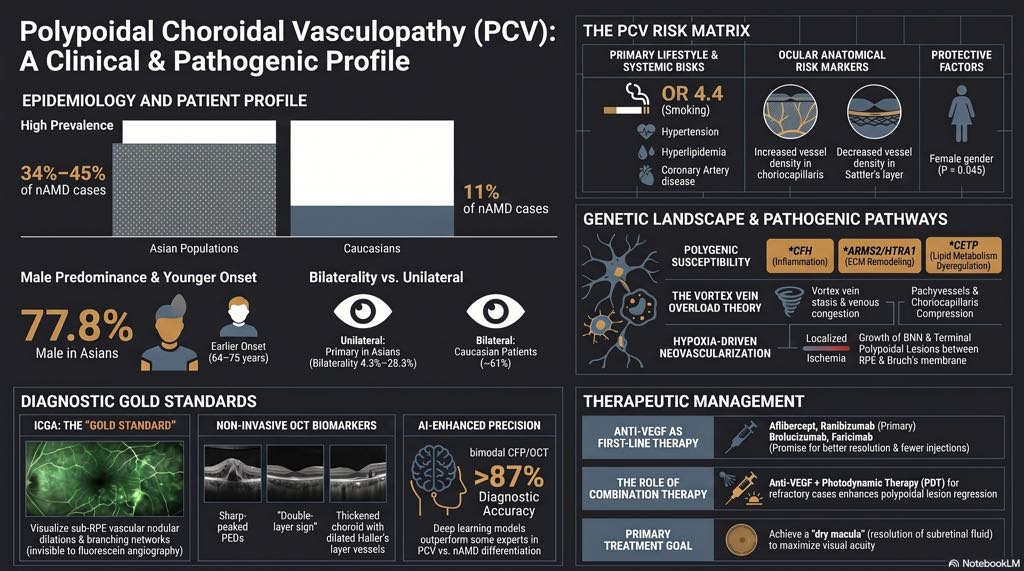
For decades, Polypoidal Choroidal Vasculopathy (PCV) was viewed primarily as a variant of neovascular age-related macular degeneration (nAMD). However, recent advancements in multimodal imaging and genetic research have solidified its status as a distinct vascular disorder characterized by sub-retinal pigment epithelium (RPE) polypoidal lesions and branching neovascular networks (BNN).

The Epidemiological and Genetic Landscape
PCV shows a striking predilection for Asian populations, where it accounts for approximately 25% to 50% of presumed nAMD cases, compared to only 8% to 16% in Caucasians. Beyond race, key risk factors include smoking, older age, and systemic metabolic issues like hyperlipidemia and hypertension. Genetically, PCV is a polygenic disorder linked to variants in CFH, HTRA1, and ARMS2, with certain markers like CETP and FGD6 being particularly significant in East Asian cohorts.
Pathogenesis: The Pachychoroid Driver
A paradigm shift in our understanding of PCV is the vortex vein overload theory. Current research suggests that chronic congestion and stagnant flow in the vortex veins lead to the formation of pachyvessels. These dilated Haller’s layer vessels compress the overlying choriocapillaris, causing localized ischemia and triggering the growth of type 1 macular neovascularization (MNV) that eventually develops into the hallmark polypoidal dilations. This “pachychoroid-driven” mechanism distinguishes most PCV cases from the traditionally “drusen-driven” nAMD pathway.
Diagnosis: Beyond the Gold Standard
While Indocyanine Green Angiography (ICGA) remains the gold standard for visualizing polyps and BNN, the shift toward non-invasive multimodal imaging is accelerating. Key OCT-based biomarkers for PCV include:
- Sharp-peaked PED (orange-nodule equivalent).
- Sub-RPE ring-like lesions.
- The “double-layer sign” indicating the presence of BNN.
- Thick choroid with dilated pachyvessels.
AI-based analysis is also emerging as a tool for precision diagnosis, helping differentiate PCV from typical nAMD with sensitivities often exceeding 85%.
The Asia-Pacific Ocular Imaging Society (APOIS) PCV Workgroup established non-invasive diagnostic criteria in 2021 to identify PCV without the need for Indocyanine Green Angiography (ICGA). These criteria utilize a combination of Color Fundus Photography (CFP) and Optical Coherence Tomography (OCT) features, categorized into major and minor criteria.
APOIS Non-ICGA Diagnostic Criteria
To achieve high diagnostic accuracy, the workgroup identified three major and four minor imaging biomarkers:
Three Major Criteria (Required):
- Sub-RPE ring-like lesion: A round or oval hyporeflective space within a Pigment Epithelial Detachment (PED) on OCT.
- En face OCT-complex RPE elevation: Complex RPE elevation visualized on en face OCT.
- Sharp-peaked PED: A steeply sloped, peaked PED (often referred to as a “thumb-like” projection).
Four Minor Criteria:
- Orange nodule: Subretinal orange-red elevated lesions visible on CFP.
- Thick choroid with dilated Haller’s layer vessels: Evidence of “pachyvessels” on OCT.
- Complex or Multilobular PED: PEDs with multiple peaks or complex internal structures.
- Double-layer sign: Two hyperreflective lines (the RPE and Bruch’s membrane) separated by a shallow layer of hyperreflective material, representing the branching neovascular network (BNN).
Diagnostic Performance
The workgroup found that a diagnosis based on all three major criteria plus at least one minor criterion achieved an Area Under the Curve (AUC) of 0.91. Interestingly, using only the three major criteria still maintained a high diagnostic performance with an AUC of 0.90.
This non-invasive approach is increasingly valuable in clinics where ICGA is unavailable or in patients for whom invasive dye-based imaging is contraindicated.
Management Strategies: Monotherapy vs. Combination
The primary goal of treatment has evolved from mere polyp closure to achieving a dry macula and optimizing visual outcomes.
- Anti-VEGF Monotherapy: First-line agents like Aflibercept and Ranibizumab are highly effective, with newer bispecific antibodies like Faricimab (targeting both VEGF-A and Ang-2) showing rapid fluid resolution and high inactivation rates.
- Combination Therapy: Adding Photodynamic Therapy (PDT) to anti-VEGF regimens significantly enhances polyp regression rates and reduces the overall injection burden, though long-term visual outcomes are often comparable to monotherapy.
Extensive clinical trials have shaped the current management of Polypoidal Choroidal Vasculopathy (PCV), primarily focusing on the efficacy of anti-VEGF agents and the benefits of combination therapy with Photodynamic Therapy (PDT).
Anti-VEGF Monotherapy Trials
Recent randomized trials demonstrate that anti-VEGF monotherapy is highly effective, gradually becoming the primary treatment modality.
- Ranibizumab:
- PEARL1 and PEARL2: Monthly injections resulted in a 33%–38% decrease in the polypoidal complex in PEARL1, while PEARL2 reported a 79% polypoidal lesion regression rate and a 26% improvement in best-corrected visual acuity (BCVA).
- LAPTOP: This trial found ranibizumab to be superior to PDT monotherapy in terms of visual outcomes.
- DRAGON: This study demonstrated significant BCVA improvements with both monthly and pro re nata (PRN) regimens over 24 months.
- Aflibercept:
- PLANET: This landmark trial showed that aflibercept achieved significant BCVA improvements or anatomical benefits in over 85% of patients, with outcomes maintained over two years.
- ALTAIR: Evaluated “treat-and-extend” (T&E) regimens, showing BCVA gains of approximately 7.5 to 8.2 letters at 12 months.
- Brolucizumab:
- HAWK: In the Japanese PCV subgroup, brolucizumab showed BCVA gains comparable to aflibercept.
- PROUD: This trial compared a personalized T&E regimen without a loading phase to a standard regimen, finding comparable efficacy and polypoidal lesion regression (94.8% vs. 100%) at 12 weeks.
- Faricimab:
- SALWEEN: This study demonstrated rapid improvements, with 86% of eyes achieving complete closure and inactivation of polypoidal lesions and an average BCVA increase of 7.8 letters.
- Conbercept:
- AURORA: This trial showed that conbercept achieved similar improvements in BCVA and polypoidal lesion regression rates comparable to aflibercept.
Combination Therapy Trials
Combination therapy, typically adding PDT to anti-VEGF agents, is often utilized for its superior ability to close polypoidal lesions.
- EVEREST and EVEREST II:
- The EVEREST study showed that combining PDT with ranibizumab was significantly superior to ranibizumab monotherapy for polypoidal lesion regression (77.8% vs. 28.6%).
- EVEREST II confirmed the superiority of combination therapy in vision improvement and reduced treatment demand over 12 and 24 months. However, a six-year follow-up revealed that long-term visual outcomes were ultimately comparable between monotherapy and combination therapy groups.
Other Modalities and Emerging Trials
- PDT Monotherapy: While the EVEREST study showed high regression rates (71.4%) with PDT alone, long-term visual outcomes are often poor due to high recurrence rates (up to 78.6% within three years).
- Radiation Therapy (INTREPID): While primarily for nAMD, stereotactic radiotherapy was shown to reduce the need for retreatment; however, its role in PCV remains under investigation due to potential microvascular complications.
- Submacular Hemorrhage (STAR): This trial compared vitrectomy to pneumatic displacement for hemorrhage, finding no significant superiority of surgery in visual acuity changes at three months.
The Road Ahead
Future research is pivoting toward gene therapy (e.g., RGX-314) and sustained-delivery systems like the port delivery system (PDS) to reduce the treatment burden. Furthermore, clarifying the role of pachydrusen and developing more accurate animal models based on vortex vein congestion will be critical to unlocking disease-specific therapies.
As we move toward a more personalized approach, recognizing PCV as a member of the pachychoroid spectrum is essential for any clinician managing posterior segment vascular disease.
Reference:
doi.org/10.1016/j.preteyeres.2025.101414


Comments are closed