
The Primary Retinal Detachment Outcomes (PRO) Study represents a massive multi-center effort to evaluate the effectiveness of different surgical interventions for rhegmatogenous retinal detachments. Utilizing a dataset of nearly 3,000 eyes, researchers analyzed various techniques such as scleral buckling, vitrectomy, and combination therapies to determine which methods yield the highest single surgery success rates. The findings emphasize that scleral buckling remains a vital tool, particularly for patients who still have their natural lenses or those with detachments in the lower portion of the eye. Beyond surgical mechanics, the reports identify key risk factors for vision loss and complications like macular edema, while also introducing a PRO Score to help clinicians predict patient outcomes. The research concludes that modern incisional repairs are highly cost-effective and that specific surgeon habits, such as minimizing the use of heavy liquids or extensive lasers, correlate with better results. Overall, these sources provide a comprehensive, data-driven framework for optimizing care in the current era of vitreoretinal surgery.

Title: Navigating Modern RRD Repair: Insights and Outcomes from the PRO Study Group
The surgical landscape for primary rhegmatogenous retinal detachment (RRD) has transformed dramatically over the last few decades, shifting from a predominant reliance on scleral buckling (SB) to a high volume of pars plana vitrectomy (PPV). While PPV accounted for only 1% of repairs in 1980, it grew to 83% by 2014. Despite this shift, the vitreoretinal community has often lacked a consensus on the “best” approach due to the many uncontrollable variables in clinical practice.
The Primary Retinal Detachment Outcomes (PRO) Study was designed to address these gaps. As a large-scale, multicenter observational study involving 61 surgeons and nearly 3,000 eyes, it provides a comprehensive look at real-world outcomes in the era of small-gauge surgery and wide-angle viewing systems.
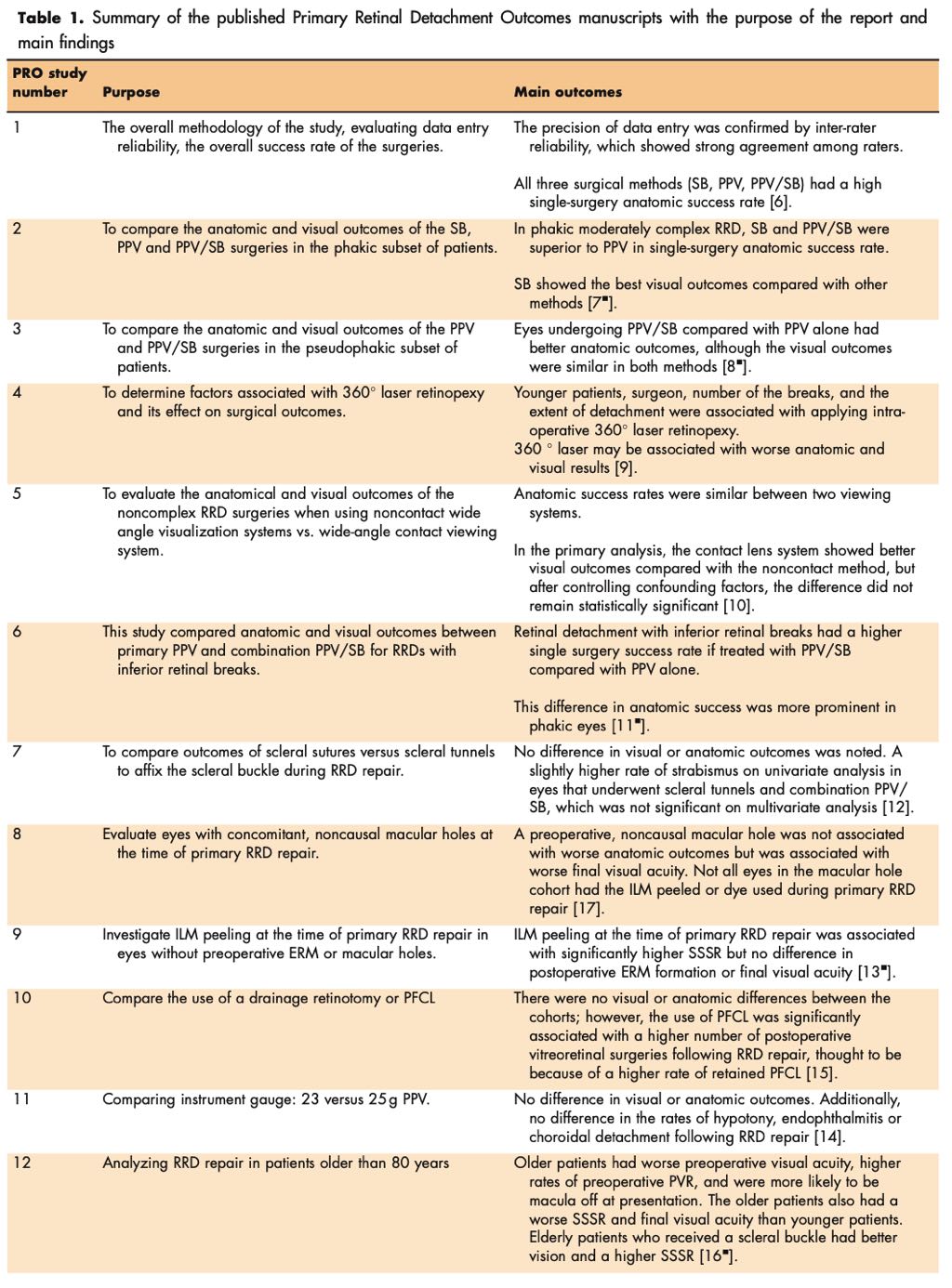
Below is a detailed breakdown of the findings from the 18 reports published to date:
Comprehensive Results from PRO Reports 1–18
- PRO 1: Methodology and Overall Success – This baseline report established the reliability of the study’s data through inter-rater agreement. It found a high overall single surgery success rate (SSSR) of 87.3%, with SB at 91.2%, PPV at 84.2%, and combined PPV/SB at 90.2%.
- PRO 2: Phakic RRD Outcomes – In phakic patients with moderately complex RRDs, scleral buckling was superior to PPV in both anatomic success and visual outcomes.
- PRO 3: Pseudophakic RRD Outcomes – For pseudophakic eyes, combined PPV/SB resulted in better anatomic outcomes than PPV alone, though final visual outcomes were similar between the two groups.
- PRO 4: 360° Laser Retinopexy – While often used in younger patients and more extensive detachments, intraoperative 360° laser was associated with lower anatomic success and worse final visual acuity when controlling for case complexity.
- PRO 5: Viewing Systems – The study compared contact vs. noncontact wide-angle viewing systems. While an initial analysis suggested better vision with contact lenses, no statistically significant difference in SSSR or final vision remained after controlling for confounding factors.
- PRO 6: Inferior Retinal Breaks – RRDs with causative breaks between the 5 and 7 o’clock meridians had a higher SSSR when treated with combined PPV/SB compared to PPV alone, a difference most pronounced in phakic eyes.
- PRO 7: Scleral Sutures vs. Tunnels – There was no significant difference in visual or anatomic outcomes between using scleral sutures or scleral tunnels (belt loops) to affix a buckle.
- PRO 8: Concomitant Macular Holes – The presence of a noncausal macular hole at the time of RRD repair did not hinder anatomic success but was associated with worse final visual acuity.
- PRO 9: ILM Peeling – Prophylactic internal limiting membrane (ILM) peeling during RRD repair (in eyes without prior macular pathology) was associated with a significantly higher SSSR (95% vs 85%), without affecting postoperative ERM formation or vision.
- PRO 10: Subretinal Fluid Drainage – Comparing perfluorocarbon liquid (PFCL) to drainage retinotomy revealed no differences in vision or SSSR. However, the PFCL cohort required more subsequent surgeries, likely due to retained subretinal PFCL.
- PRO 11: Instrument Gauge (23g vs. 25g) – No significant differences were found in visual outcomes, SSSR, or complications like hypotony and endophthalmitis between 23-gauge and 25-gauge PPV.
- PRO 12: Outcomes in the Elderly (>80 years) – Patients over 80 often presented with more complex, “macula-off” detachments. These patients had worse SSSR and vision than younger cohorts, but elderly patients who received a scleral buckle fared better than those who did not.
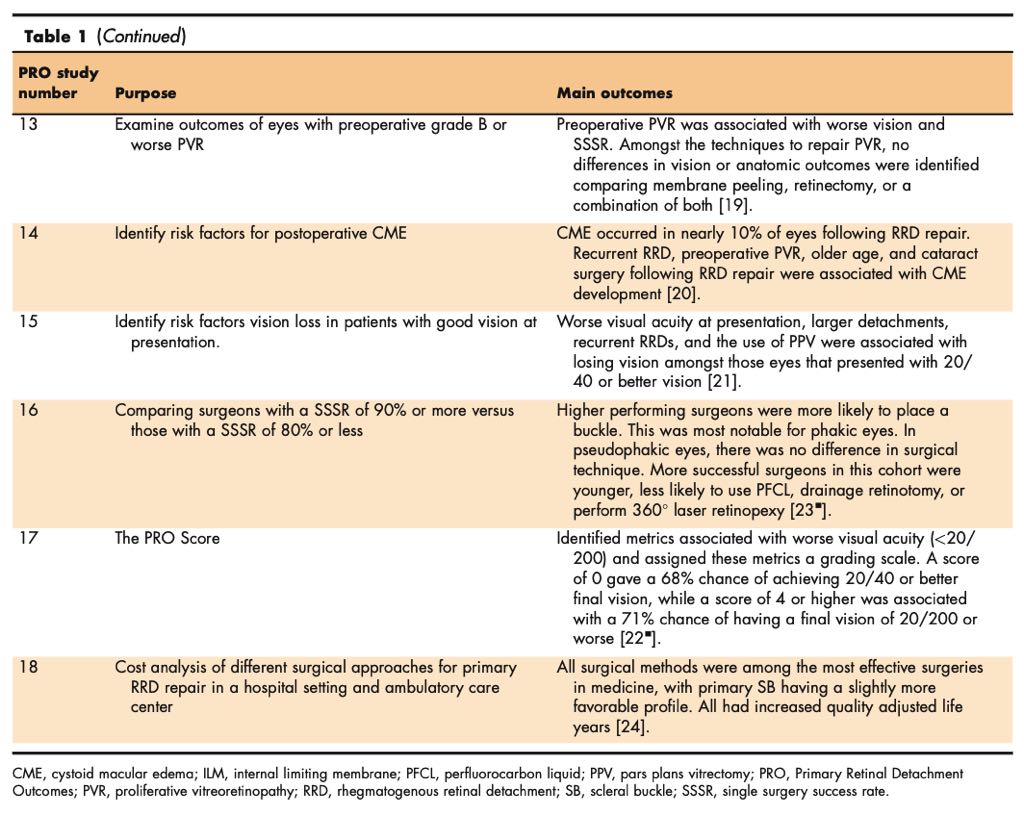
- PRO 13: Proliferative Vitreoretinopathy (PVR) – Preoperative Grade B or C PVR was predictably associated with worse SSSR and vision. No single surgical technique (membrane peeling vs. retinectomy) showed clear superiority for these cases.
- PRO 14: Cystoid Macular Edema (CME) – Postoperative CME occurred in approximately 10% of eyes. Key risk factors included older age, preoperative PVR, recurrent RRD, and subsequent cataract surgery.
- PRO 15: Vision Loss in “Good Vision” Presentations – In eyes presenting with 20/40 or better vision, 16.4% lost that level of acuity. Risk factors for vision loss included the use of PPV, larger detachments, and recurrent RRDs.
- PRO 16: High-Performing Surgeon Characteristics – Surgeons with an SSSR ≥90% were more likely to utilize scleral buckles, particularly in phakic eyes. High performers in pseudophakic cases tended to use less PFCL, less 360° laser, and fewer drainage retinotomies.
- PRO 17: The PRO Score – A novel predictive algorithm was developed to forecast visual outcomes based on preoperative factors (e.g., age, PVR, choroidal detachment, and vision loss duration). A score of 0 predicts a 68% chance of 20/40 vision, while a score ≥4 suggests a 71% chance of 20/200 or worse vision.
- PRO 18: Cost-Effectiveness – All incisional RRD repair modalities were found to be highly cost-effective, with primary SB showing the most favorable cost-per-quality-adjusted life year profile.
The PRO Score is a novel predictive algorithm, developed by the Primary Retinal Detachment Outcomes (PRO) Study Group, designed to forecast a patient’s final visual acuity following the surgical repair of a primary rhegmatogenous retinal detachment (RRD). Using an artificial intelligence algorithm, the study identified specific preoperative risk factors associated with poor final visual outcomes (defined as worse than 20/200) and assigned them point values.
The Scoring System
Points are assigned based on the following preoperative metrics:
- 2 Points: Preoperative choroidal detachment and a history of anti-vascular endothelial growth factor (VEGF) injections.
- 1 Point: Preoperative proliferative vitreoretinopathy (PVR), vision loss duration of more than one week, presence of other ocular comorbidities, poor presenting visual acuity, and age over 70 years.
Predictive Outcomes for Visual Recovery
The total score provides a statistical probability for the patient’s visual recovery:
- Score of 0: Patients have a 68% chance of achieving “good” final vision (20/40 or better) and only an 8% chance of ending up with 20/200 or worse vision.
- Score of 4 or Higher: The prognosis is significantly more guarded, with only a 29% chance of achieving 20/40 or better vision and a 71% chance of a final visual acuity of 20/200 or worse.
This scoring system functions similarly to the ocular trauma score, providing clinicians with a tool to manage patient expectations and identify high-risk cases based on their initial clinical presentation.
Clinical Takeaways
The PRO Study reinforces the continued clinical relevance of the scleral buckle, both as a primary procedure and an adjunct, particularly in phakic eyes, elderly patients, and those with inferior breaks. While the “perfect” study of RRD may be impossible due to the heterogeneity of the condition, the PRO database offers a powerful evidence-based toolkit to help surgeons tailor their approach to each unique patient encounter.

Phacovitrectomy vs. Vitrectomy in 2026: Which is Better for Retinal Detachment?
When a patient presents with a rhegmatogenous retinal detachment (RRD), surgeons often face a critical choice: perform a standard pars plana vitrectomy (PPV) or combine it with cataract surgery, a procedure known as phacovitrectomy. A recent large-scale study utilizing the BEAVRS/EURETINA RD Outcomes Dataset provides new insights into which approach yields better results for patients aged 45 and older.
A Study of Over 6,000 Eyes
The study analyzed data from 9,062 primary RRD eyes, ultimately narrowing the cohort to 6,113 eyes for anatomical analysis and 4,726 eyes for visual analysis. Interestingly, patients selected for phacovitrectomy often presented with more complex disease at baseline, including older age, longer duration of vision loss, worse initial visual acuity, and higher rates of proliferative vitreoretinopathy (PVR).
Anatomical Success: High Across the Board
The good news for patients is that primary anatomical success was high regardless of the surgical choice. Before matching the groups for complexity, 90.5% of PPV eyes and 92.6% of phacovitrectomy eyes achieved complete retinal reattachment. This suggests that both techniques are highly effective at physically repairing the retina.
Visual Outcomes: The Phacovitrectomy Advantage
While anatomical success was similar, the visual outcomes told a different story. After adjusting for baseline differences, phacovitrectomy was significantly associated with better final visual acuity. Specifically, patients who underwent the combined procedure gained approximately 3 letters more (a -0.056 logMAR gain) compared to those who had PPV alone.
Navigating Complications
Surgeons must weigh these visual gains against potential complications. The study found that:
- Cystoid Macular Oedema (CMO): This was significantly more common in the phacovitrectomy group (1.94% vs. 0.35% for PPV).
- Epiretinal Membrane (ERM): This complication was more frequent in the PPV-only group (3.13% vs. 2.42% for phacovitrectomy).
- Other complications, such as macular folds, hypotony, and postoperative hemorrhage, remained infrequent and did not differ significantly between the two groups.
Final Verdict
For patients over 45, phacovitrectomy appears to offer a slight but statistically significant advantage in final visual acuity, despite a slightly higher risk of CMO. By combining the procedures, surgeons may provide a more efficient path to visual recovery, especially since many PPV patients eventually require cataract surgery later anyway.

Reference Gough M, et al. Phacovitrectomy Versus Vitrectomy for Retinal Detachment Outcomes. Ophthalmology Retina. 2026;10(8):691-699..


Comments are closed