
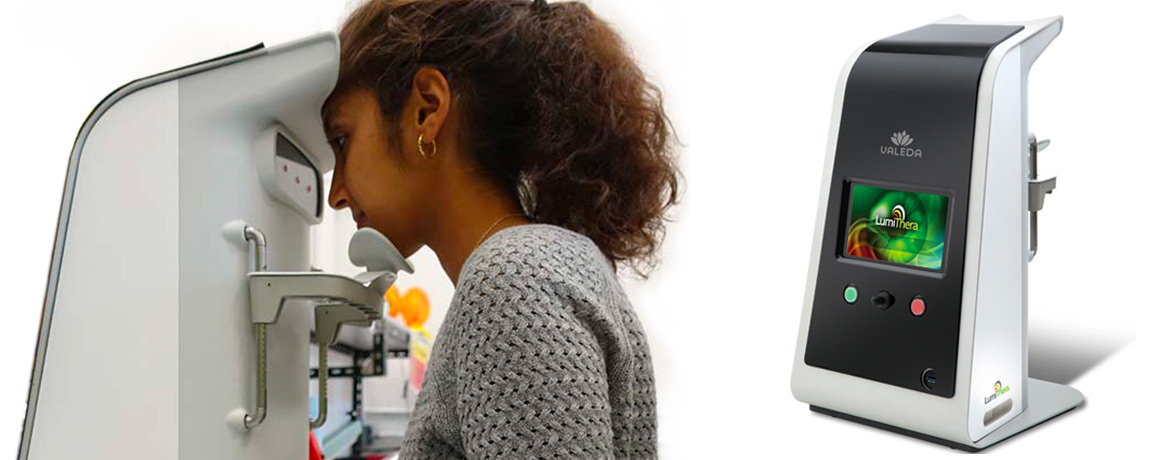
Summary:
-
Overview of Age-related Macular Degeneration (AMD):
-
AMD: Leading cause of irreversible vision loss in elderly; affects 196 million globally, projected to reach 288 million by 2040.
-
Non-exudative (dry) AMD: Majority of cases; characterized by drusen accumulation and macular thinning.
-
Exudative (wet) AMD: Involves neovascularization, leakage, and scarring.
-
Beckman Classification (2013):
-
No aging changes: No drusen or pigmentary abnormalities.
-
Normal aging: Small drusen (≤63 μm), no pigmentary changes.
-
Early AMD: Drusen >63 μm and ≤125 μm.
-
Intermediate AMD: Drusen >125 μm.
-
Late AMD: Geographic atrophy (GA) or exudative AMD.
-
-
Pathogenesis: Multifactorial—genetic variants (e.g., CFH, ARMS2), aging, chronic inflammation, oxidative stress, and mitochondrial dysfunction.
-
-
Current Treatments for Non-exudative AMD:
-
Intermediate AMD: Limited to lifestyle modifications (e.g., smoking cessation, diet) and AREDS vitamin supplementation.
-
Geographic Atrophy: Recent FDA approvals for pegcetacoplan and avacincaptad pegol to slow progression.
-
No therapies reverse damage or improve vision in early/intermediate stages.
-
-
Photobiomodulation Therapy (PBT):
-
Definition: Noninvasive therapy using red/near-infrared light (600–1000 nm) via LED or laser to stimulate cellular processes.
-
Mechanism:
Targets mitochondria, enhancing cytochrome c oxidase activity, increasing ATP production, and reducing oxidative stress.
Increases nitric oxide bioavailability, promoting vasodilation and cellular function.
Modulates gene expression to enhance cell migration, proliferation, and antioxidant production; reduces apoptosis.
Protects Muller cells (retinal glial cells), preventing gliosis and inflammation, supporting photoreceptor survival.
-
-
Goal in AMD: Slow progression, preserve visual acuity, and improve retinal health by addressing mitochondrial dysfunction, inflammation, and oxidative stress.
-
-
Pathophysiology of Non-exudative AMD:
-
Affects macula lutea (highest cone density, central vision).
-
Retinal pigment epithelium (RPE) dysfunction: Key role in light absorption, phagocytosis, nutrient transport, and cytokine secretion.
-
Drusen: Extracellular deposits (lipids, vitronectin, apolipoproteins, inflammatory/amyloid proteins) beneath RPE; cause RPE detachment and photoreceptor loss.
-
Genetic factors: Variants in complement factor H (CFH) and ARMS2 linked to complement dysregulation and proinflammatory environment.
-
Aging: Increases reactive oxygen species (ROS), overwhelming autophagy, leading to retinal degeneration.
-
Mitochondrial dysfunction: Reduced mitochondrial proteins (e.g., heat shock proteins, electron transport chain); RPE relies on glycolysis, starving photoreceptors.
-
-
Animal Studies on PBT:
-
Rat models: 670 nm LED PBT slowed light-induced AMD progression; improved photoreceptor function (electroretinogram).
-
Reduced inflammation, complement factors (e.g., C3), and outer nuclear layer thinning.
-
CFH knockout mice: 670 nm PBT (6 min, twice daily, 14 days) decreased inflammatory markers and enhanced mitochondrial function.
-
Multiwavelength PBT (680, 780, 830 nm): Prevented RPE damage, retinal apoptosis, and rod bipolar cell depletion in sodium iodate-induced AMD rats.
-
-
Human Studies and Clinical Trials:
-
Ivandic et al. (2008): 348 eyes, 780 nm PBT (transconjunctival); improved visual acuity (sustained up to 36 months), reduced metamorphopsia, scotoma, and dyschromatopsia.
-
TORPA Study:
-
Used Warp10 and Gentlewaves devices; 18 treatments over 6 weeks.
-
Significant improvements in visual acuity (P<0.0001) and contrast sensitivity (P<0.0032) at 6 weeks and 1 year.
-
-
TORPA II Study:
-
590/790 nm wavelengths, 3-week treatment.
-
Visual acuity improved by 5.14 letters (P<0.001); contrast sensitivity improved by 0.11–0.16 log units (P=0.02).
-
Drusen volume decreased by 0.024 mm³ (P<0.001); central drusen thickness reduced by 3.78 μm (P<0.001).
-
-
LIGHTSITE I Study (Valeda Light Delivery System, 590/660/850 nm, 3x/week, 3–4 weeks):
-
Improved contrast sensitivity (+0.35 log units, month 12), drusen volume (P=0.05), drusen thickness (P=0.03), and quality of life (P=0.003–0.015).
-
BCVA gains in high responders (≥5 letters) at early AMD stages; less benefit in advanced disease.
-
-
LIGHTSITE II Study (53 eyes, intermediate AMD, 9 sessions over 3–5 weeks at months 0, 4, 8, 9):
-
BCVA gain of 3.94 letters (P=0.02) in PBT group vs. 0.5 letters (P=0.10) in sham at 9 months; 35.3% achieved >5-letter gain.
-
Drusen volume stable in PBT group (+0.0003 mm³) vs. increase in sham (+0.032 mm³, P>0.05).
-
GA growth reduced in PBT group (0.73 mm² vs. 1.29 mm² in sham, P=0.46, confounded by baseline lesion size).
-
-
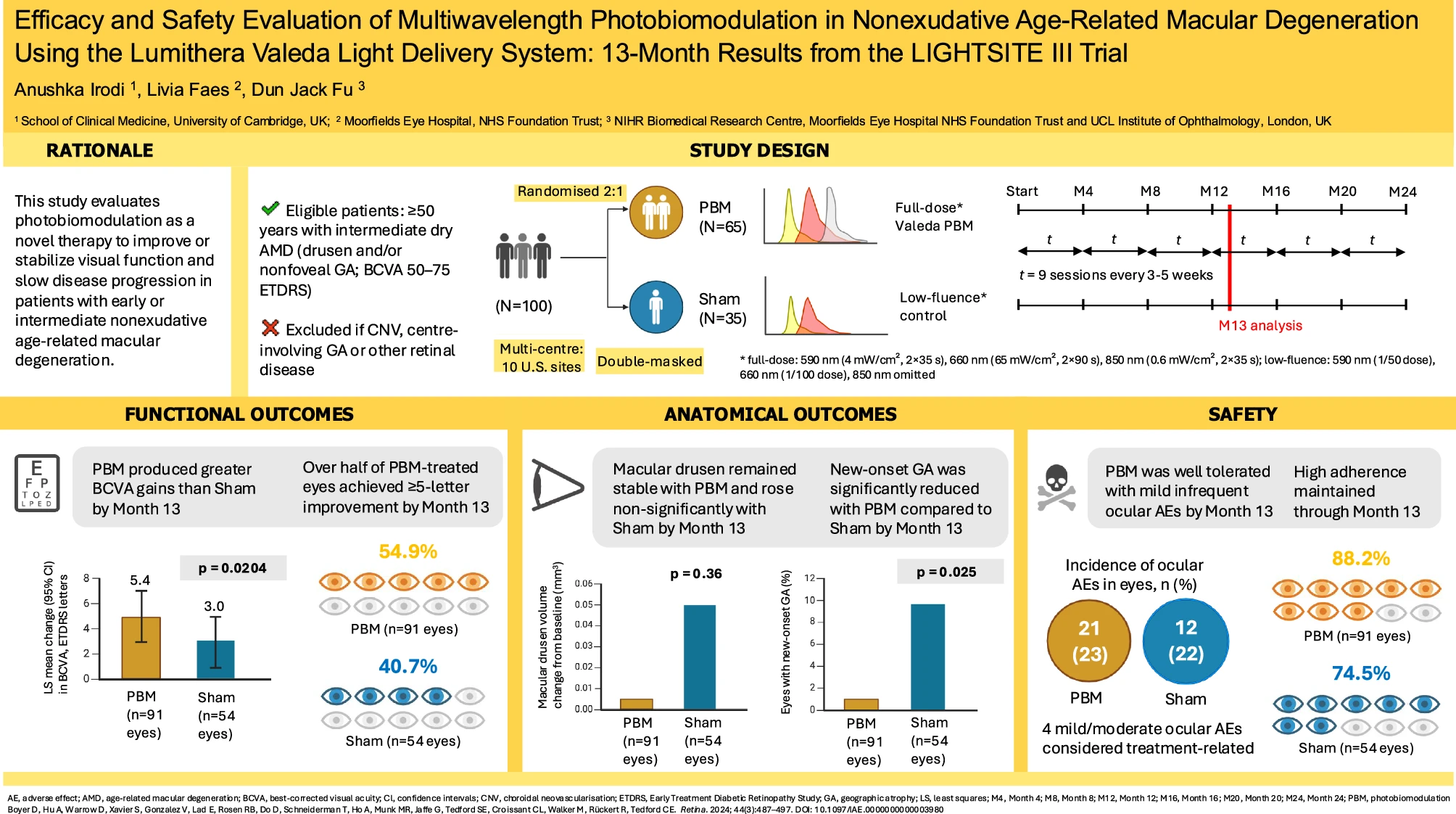
LIGHTSITE III Study (148 eyes, 9 sessions every 4 months, 24 months):
BCVA gain: 5.4 letters (P<0.0001) in PBT vs. 3.0 letters (P=0.0094) in sham at 13 months; significant between-group difference (P=0.0204).
Over 58% achieved >5-letter gain.
New-onset GA: 1.1% (PBT) vs. 10% (sham) at 13 months (P=0.024).
Drusen volume: Non-significant difference (0.947 mm³ PBT vs. 1.02 mm³ sham, P=0.36).
-
-
ELECTROLIGHT Study (23 eyes, Valeda, 3x/week, 3 weeks):
-
BCVA improved by 12.6 letters at 1 month, 12.8 letters at 6 months.
-
Contrast sensitivity improved at multiple distances (P<0.05).
-
Electroretinography: 14.4% increase in multifocal ERG magnitude (P=0.001).
-
-
DRUSEN Study (152 eyes, EYE-LIGHT, 590/630 nm, 2x/week, 4 weeks):
-
High tolerability, minimal adverse effects.
-
BCVA stable in PBT group (+0.48 letters, P=0.184); significant vs. sham (P=0.026).
-
Drusen volume reduction significant vs. sham (P=0.013).
-
-
-
Ongoing Trials:
-
LIGHTSITE IIIB (NCT06229665): Phase 2/3, 75 subjects, Valeda system, 9 treatments over 3–5 weeks, re-treated at 4, 8, 12 months; primary outcome: BCVA.
-
EUROLIGHT (NCT06351605): Multicenter, 500 subjects, Valeda system, 9 treatments over 3–4 weeks, up to 5 rounds every 4–6 months; primary outcome: BCVA; secondary: retinal thickness, drusen volume, GA.
-
-
Limitations and Future Directions:
-
Challenges: Small sample sizes, variable treatment protocols (wavelengths, frequency), and limited long-term follow-up.
-
Unanswered questions: Optimal treatment algorithms, durability, and ideal patient populations (e.g., early vs. intermediate AMD).
-
Future trials aim to address larger cohorts, global populations, and long-term outcomes.
-
Citation
Rodriguez DA, Song A, Bhatnagar A, Weng CY. Photobiomodulation Therapy for Non-exudative Age-related Macular Degeneration. Int Ophthalmol Clin. 2025;65(1):47-52. doi:10.1097/IIO.0000000000000543
Efficacy and safety evaluation of multiwavelength photobiomodulation in nonexudative age-related macular degeneration using the Lumithera Valeda Light Delivery System: 13-month results from the LIGHTSITE III trial
References
- Boyer D, Hu A, Warrow D, Xavier S, Gonzalez V, Lad E. LIGHTSITE III: 13-month efficacy and safety evaluation of multiwavelength photobiomodulation in nonexudative (dry) age-related macular degeneration using the Lumithera Valeda Light Delivery System. Retina. 2024;44:487–97. https://doi.org/10.1097/IAE.0000000000003980.


