

1. The PDR Management Shift: Beyond Laser Monotherapy
For nearly half a century, Panretinal Photocoagulation (PRP) has been the cornerstone of Proliferative Diabetic Retinopathy (PDR) management. While the efficacy of laser in preventing severe vision loss is unquestioned, its destructive nature—leading to permanent peripheral field loss, impaired night vision, and potential exacerbation of macular edema—has prompted a search for more physiological alternatives.
The introduction of anti-vascular endothelial growth factor (anti-VEGF) therapies has fundamentally shifted this landscape, moving us from tissue destruction toward disease modification. The CONDOR trial investigates brolucizumab 6 mg, a single-chain antibody fragment (scFv). Its low molecular weight (26 kDa) and high molar concentration allow for enhanced tissue penetration and a high affinity for VEGF-A, potentially offering superior “drying” and anti-angiogenic effects. CONDOR specifically addressed the efficacy and safety of brolucizumab compared directly to PRP in eyes with treatment-naïve PDR.
2. CONDOR Study Design: A Unique Trial Architecture
The CONDOR trial was a 96-week phase 3 study designed to isolate the impact of brolucizumab on the proliferative process by enrolling patients without baseline center-involved diabetic macular edema (CI-DME).
Trial Parameters
| Parameter | Details |
| Design | Single-masked, multicenter, randomized (1:1) clinical trial |
| Countries | 16 countries across 152 global sites |
| Participant Count | 689 randomized (Brolucizumab: 347, PRP: 342) |
| Inclusion Criteria | PDR diagnosis (investigator-graded), no prior PRP, no baseline CI-DME |
| Dosing Regimen | 3 loading doses (Q6W), followed by Q12W maintenance |
A critical aspect of the trial architecture for the modern clinician is the flexibility of the maintenance phase. Starting at week 48, investigators had the option to extend treatment intervals by 6-week increments up to a Q24W (6-month) interval based on disease activity, significantly addressing the historical concern of treatment burden associated with anti-VEGF monotherapy for PDR.
3. Functional Outcomes: Superiority in Visual Acuity
The primary endpoint assessed the change from baseline in Best-Corrected Visual Acuity (BCVA) at week 54. The data demonstrated that pharmacologic intervention not only met the noninferiority margin but achieved statistical superiority over laser.
Primary Outcome: Brolucizumab 6 mg met both noninferiority and superiority thresholds for BCVA change at week 54 compared to PRP.
- Brolucizumab 6 mg: +0.2 letters
- PRP: -4.2 letters
- LSM Difference: 4.4 letters (95% CI, 2.4-6.4; P < .001)
At a baseline mean BCVA of 77.1 letters (approximately 20/32 Snellen equivalent), the 4.4-letter difference underscores a clinically meaningful divergence: brolucizumab maintained visual stability, while the PRP cohort experienced a modest functional decline.
4. Anatomical Impact: Reversing Disease Progression
Brolucizumab’s small molecular size and high molar concentration translated into robust anatomical regression of neovascularization. Secondary endpoints at week 54 revealed:
- PDR Resolution: 63.6% of brolucizumab eyes achieved “no PDR” status at week 54 compared to only 22.4% in the PRP arm (P < .001).
- DRSS Improvement: Brolucizumab demonstrated clear superiority in disease regression, with 45.4% of patients achieving a ≥2-step improvement (vs. 20.4% for PRP) and 20.6% achieving a ≥3-step improvement (vs. 10.8% for PRP).
- VTC Prevention: The incidence of Vision-Threatening Complications (VTCs) was significantly lower in the brolucizumab arm (33.7%) vs. the PRP arm (75.4%). This endpoint included critical events such as vitreous hemorrhage, retinal detachment, neovascular glaucoma, iris/angle neovascularization, and the need for vitrectomy.
5. The DME Prevention Advantage
The development of CI-DME is a frequent and vision-impairing complication of PDR, often exacerbated by PRP. In CONDOR, only 31.1% of brolucizumab-treated eyes experienced a CI-DME event up to week 54, compared to a staggering 72.7% in the PRP group.
From an academic perspective, it is important to note that the Central Reading Center (CRC) utilized a central subfield thickness (CST) cutoff of ≥280 μm to define CI-DME. This threshold is lower than what is typically used in clinical practice, which likely explains the high incidence rates in both arms but highlights the superior “drying” efficacy of brolucizumab previously noted in the KESTREL and KITE trials.
6. Safety Analysis: Addressing Intraocular Inflammation (IOI)
Safety remains a focal point for brolucizumab. The CONDOR trial provided a transparent look at the ocular safety profile in a PDR cohort.
Safety Outcomes (Baseline to Week 54)
| Outcome | Brolucizumab 6 mg (n=347) | PRP (n=342) |
| Overall Ocular Adverse Events | 34.3% | 49.1% |
| Intraocular Inflammation (IOI) | 5.2% | 0.6% |
| Retinal Vascular Occlusion (RVO) | 0.9% | 0.3% |
| Serious Ocular Adverse Events | 2.9% | 6.4% |
| Loss of ≥15 letters | 4.7% | 10.7% |
While the IOI rate (including retinal vasculitis) was 5.2% in the brolucizumab arm—consistent with its established profile—it is essential to balance this against the functional outcomes. Patients in the PRP arm were more than twice as likely to experience significant vision loss (≥15 letters) compared to those in the brolucizumab arm (10.7% vs 4.7%).
7. Contextualizing CONDOR: Protocol S and CLARITY
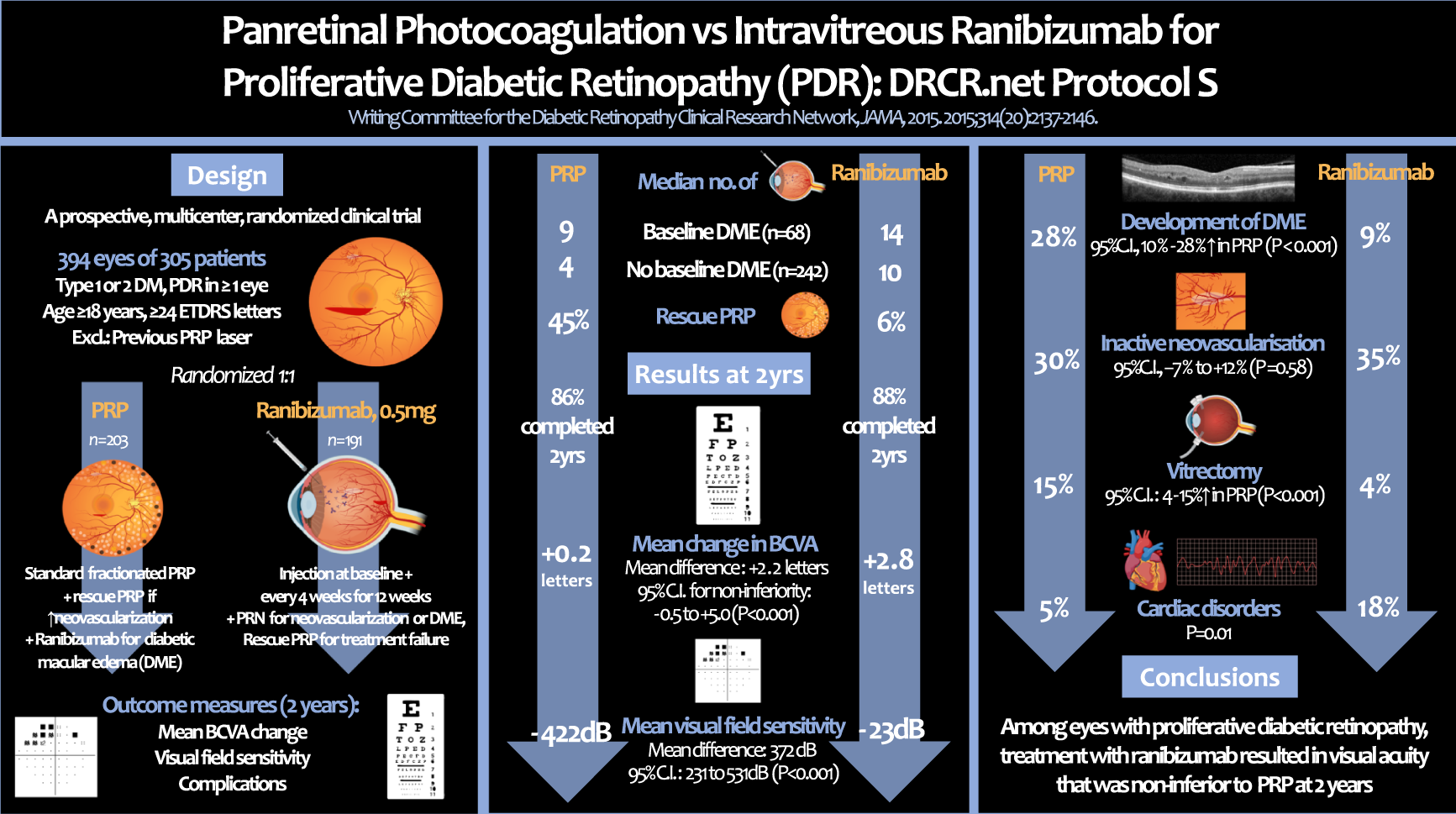
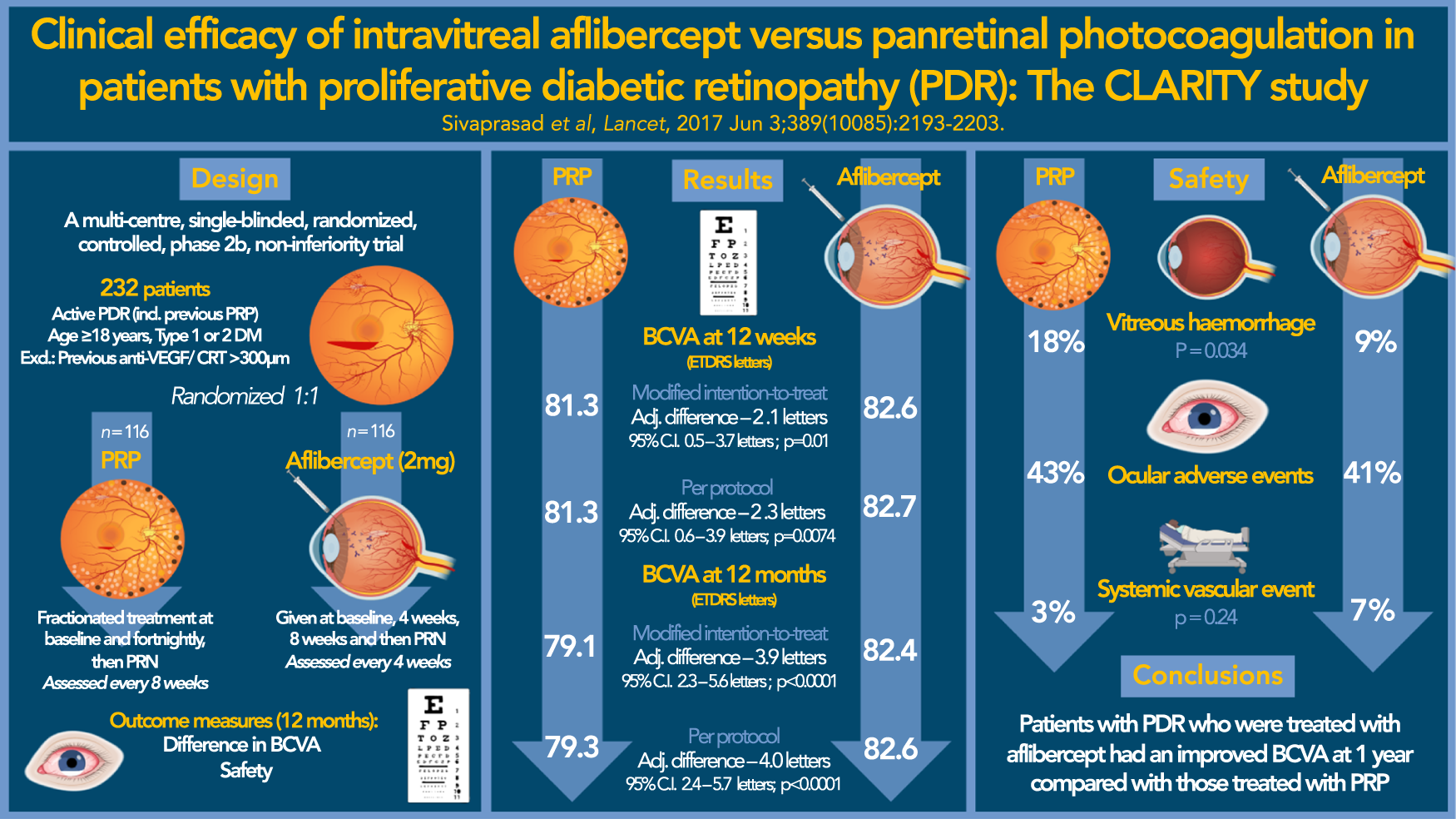
To appreciate CONDOR’s contribution, one must look at its predecessors. Unlike Protocol S (ranibizumab), where many patients had baseline DME and received anti-VEGF regardless of their randomization, CONDOR excluded baseline CI-DME to specifically evaluate the PDR response. Furthermore, unlike CLARITY (aflibercept), which included a cohort where over 40% had prior PRP, CONDOR focused exclusively on PRP-naïve eyes.
However, an academic review of CONDOR must acknowledge a notable discrepancy: while investigators classified 100% of patients as having PDR at baseline, CRC grading determined that 14.9% actually had NPDR. This “real-world” investigator variability is a known phenomenon in large-scale trials but serves as a reminder of the challenges in standardizing DR severity grading.
8. Clinical Interpretation and Moving Forward
Clinical Bottom Line: The CONDOR trial establishes brolucizumab 6 mg as a potent alternative to PRP for treatment-naïve PDR. It demonstrated superiority in preserving visual acuity and achieving anatomical resolution of PDR while offering a significantly reduced treatment burden through potential extension to Q24W intervals.
For the retina specialist, the decision-making process must be balanced. Brolucizumab effectively halved the risk of significant vision loss and protected against the development of DME compared to PRP. However, these benefits must be weighed against the 5.2% IOI rate. When managing a treatment-naïve PDR patient, brolucizumab should be considered a first-line option, particularly for those where preserving the peripheral field or preventing DME is a priority, provided that patient compliance and the clinical capacity for long-term monitoring are secured.

9. References and Attribution
- Wolf S, et al. Brolucizumab in the Treatment of Proliferative Diabetic Retinopathy: The CONDOR Randomized Clinical Trial. JAMA Ophthalmol. 2026;144(6):500-507.
- Trial Identifier: NCT04278417


