
1. Introduction: The High Stakes of Preventable Blindness
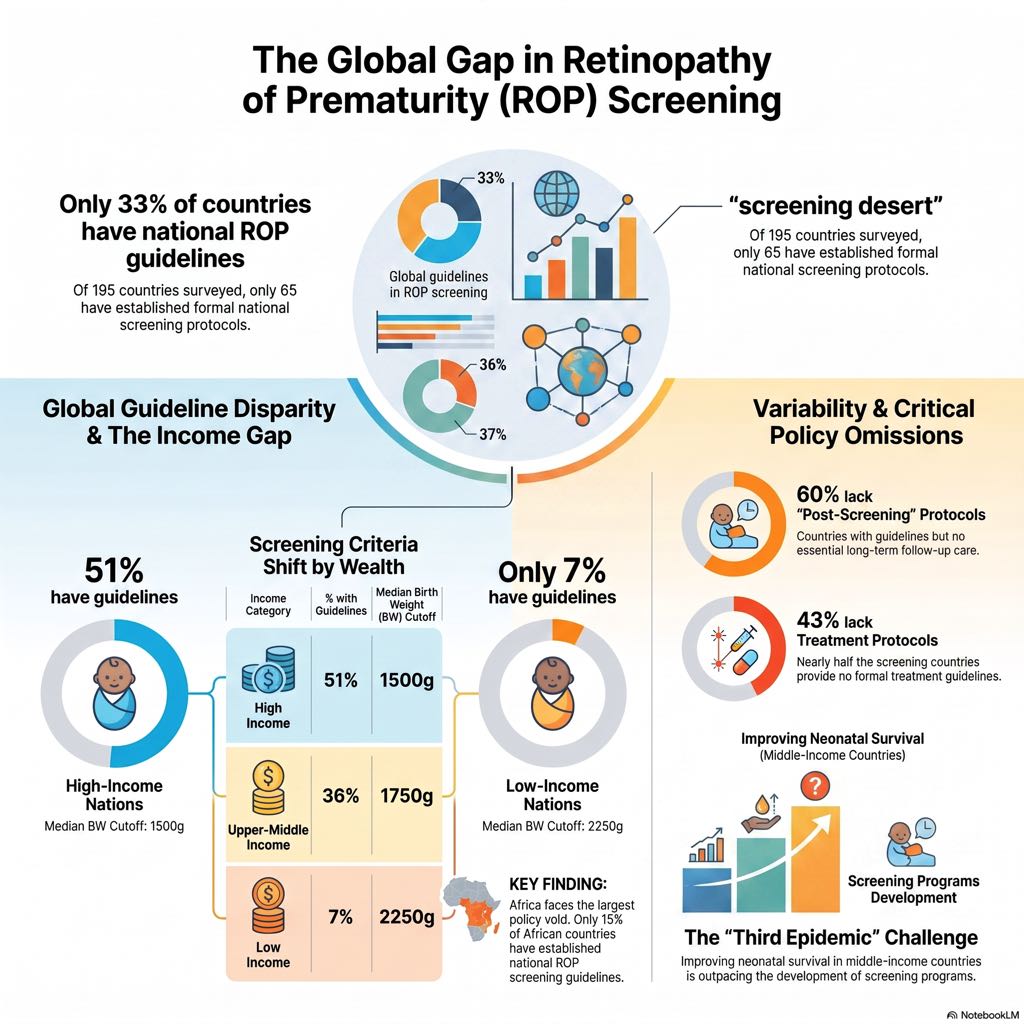
Retinopathy of prematurity (ROP) remains a catastrophic leading cause of preventable childhood blindness. As a clinical community, we are currently grappling with the “Third Epidemic”—a systemic failure where rising neonatal survival in middle-income countries has tragically outpaced the development of essential screening and treatment infrastructure. This is not merely a statistical trend; it is a critical global healthcare failure. While medical advances allow smaller, younger infants to survive, the absence of regulated oxygen use and specialized vitreoretinal care leaves a growing population of children at risk for permanent vision loss.
This global analysis establishes a comprehensive review of ROP national guidelines across all 195 UN-recognized countries. By meticulously identifying variances and critical policy gaps, we provide a necessary framework for resource-matched intervention to halt the tide of preventable blindness.
2. The State of Global ROP Policy: A Statistical Overview
Our investigation identifies a staggering deficiency in formal ROP governance. Only 65 of the 195 countries surveyed (33%) possess formal national screening guidelines. The geographic distribution of these policies reveals massive “screening deserts,” particularly across Africa and Oceania.
| Region | Prevalence of National ROP Guidelines (%) |
| South America | 58% |
| Europe | 50% |
| North America | 39% |
| Asia | 35% |
| Africa | 15% |
| Oceania | 14% |
There is a stark, non-negotiable correlation between a nation’s economic status and the safety of its neonatal population. Countries with established national guidelines possess a median GDP per capita of $13,448, while those abandoned to policy vacuums operate at a median of just $5,149.
3. Screening Criteria: The GA and BW Divide
Screening protocols are traditionally anchored by Gestational Age (GA) and Birth Weight (BW) cutoffs, yet the global landscape is defined by clinical chaos and extreme variability.
| Income Category | Median GA Cutoff (weeks) | Median BW Cutoff (grams) |
| High Income | 32 | 1500 |
| Upper-Middle Income | 33.5 | 1750 |
| Lower-Middle Income | 32 | 1500.5 |
| Low Income | 32 | 2250 |
The disparity at the extremes is alarming: nations such as Nicaragua, Serbia, Peru, and Ukraine utilize GA cutoffs as high as 37 weeks, whereas Sweden, South Korea, and the United States maintain a narrow 30-week threshold. This 7-week disparity represents a massive clinical gap.
In low-income nations, the median BW cutoff of 2250g is a significant outlier compared to the 1500g standard of high-income nations. This broader criteria is a clinical necessity; in resource-limited settings, ROP is not solely a disease of the “ultra-premature,” but rather a disease of preventable oxygen toxicity in near-term infants. The lack of oxygen blenders and continuous saturation monitoring means that “larger, more mature” infants—who would be considered low-risk in the West—are routinely blinded in Sub-Saharan Africa due to unblended oxygen exposure.
4. Beyond the Numbers: Additional Screening Determinants
While GA and BW are primary triggers, 68% of countries with guidelines incorporate supplemental systemic risk factors. However, the lack of standardization remains a hurdle.
Commonly cited comorbidities include:
- Oxygen or Ventilatory Therapy (40%): Critically, countries vary on the duration of therapy required to trigger screening, illustrating a lack of standardized duration metrics across borders.
- Sepsis (23%): A frequent trigger for localized inflammation and vascular instability.
- Other Factors: Includes blood transfusions and respiratory distress syndrome.
Alarmingly, despite the proliferation of predictive algorithms like WINROP and G-ROP in academic centers, no nation has yet formally endorsed these “risk-tailored” approaches at a national policy level.
5. Critical Deficits in Follow-up and Treatment Protocols
The mere existence of a screening guideline does not equate to a functional clinical program. Even in countries with screening protocols, the management of the “acute phase” and long-term sequelae is riddled with gaps.
Primary Policy Deserts:
- Acute Phase Schedule Gaps: 49% lack standardized examination schedules.
- Termination Gaps: 51% lack definitive criteria for ending the acute phase of screening.
- Long-term Follow-up Gaps: 60% provide no guidance for late complications such as strabismus, glaucoma, or amblyopia.
The treatment landscape is even more fractured. A significant 43% of countries with screening guidelines entirely lack corresponding treatment protocols. Among those that do, 68% rely on ETROP disease classifications. Furthermore, treatment timing is dangerously inconsistent: while Kenya and Belize mandate intervention within 24–48 hours, others like Chile and Norway allow up to 72 hours, a delay that can be the difference between salvage and permanent retinal detachment.
6. The “Third Epidemic” and Resource Misalignment
A central tenet of global health is that high-income guidelines (such as the AAP) are “dangerously narrow” when applied to LMICs. They fail to protect infants in settings where oxygen management is imprecise. Furthermore, screening often occurs in “atypical venues”—peripheral units or outpatient clinics—where specialized equipment like pediatric retinal cameras is absent.
Telemedicine and AI are frequently championed as solutions to this screening burden. However, a critical regulatory hurdle remains: there is currently no FDA-approved algorithm for autonomous diagnosis. Human expert graders remain a clinical necessity, and the financial barriers to acquiring digital imaging hardware remain a significant roadblock to widespread policy implementation.
7. Strategic Recommendations for Retina Specialists and Policymakers
To address this global disparity, we propose four urgent strategic actions:
- Empiric “Broader-to-Narrower” Refinement: Countries lacking robust local data must initially adopt broad screening criteria (higher GA/BW) to capture the at-risk “larger” infants, refining these cutoffs only after safety is demonstrated through local evidence.
- Universal Data Registries: We must establish national and NICU-level ROP registries to aggregate outcomes and move toward evidence-based local practices.
- Global Skills and Equipment Transfer: International partnerships must focus on capital investment in retinal cameras and the transfer of surgical skills to manage aggressive posterior ROP.
- Formalization of Consensus: High-income countries (e.g., Italy, Greece) currently relying on “informal consensus” must formally publish national guidelines. Relying on foreign protocols leads to legal ambiguity and internal inconsistency within national health systems.
8. Conclusion: A Call for Global Synchronization
The prevalence of “screening deserts,” particularly across the African continent, represents a fundamental failure in global health equity. Standardized, resource-matched guidelines are not bureaucratic suggestions; they are the essential clinical tools required to achieve the goal of zero preventable blindness from ROP. We must close these policy gaps to ensure that a child’s vision is not determined by the presence or absence of an oxygen blender in their birth hospital.

9. Bibliography
Ahmad, N., Chaaya, C., Pandiri, S., et al. (2026). Retinopathy of prematurity: A global review of screening guidelines. Survey of Ophthalmology. https://doi.org/10.1016/j.survophthal.2026.05.003


