Here’s a concise, structured summary of the article “Hyperacute Outer Retinal Dysfunction – HORD ” from JAMA Ophthalmology (2025):
🧾 Overview
- Condition described: Hyperacute Outer Retinal Dysfunction (HORD) — a proposed new pediatric retinal disease entity.
- Key features: Sudden, severe bilateral vision loss in children after a febrile illness, with diffuse ellipsoid zone (EZ) and external limiting membrane (ELM) disruption on OCT.
- Study type: Multicenter case series of 8 children (16 eyes) in China, aged 3–7 years.
- Timeframe: November 2022 – May 2023, with ~1 year follow-up.
🔍 Clinical Presentation
- Onset: Mean 16 days after fever (often from common cold–like illness).
- Symptoms:
- Sudden severe vision loss (all patients)
- Visual field constriction (100%)
- Nyctalopia (50%)
- Color vision abnormalities (25%)
- Initial VA: Mostly hand motion or light perception.
- Fundus: Often normal early; mild vascular attenuation in some.
- OCT early signs:
- Angular sign of Henle fiber layer hyperreflectivity (ASHH)
- Hyperreflective dots (HRD)
- Blurred EZ and intact ELM initially, progressing to EZ/ELM loss.


📊 Disease Course & Imaging
- Progression:
- Rapid outer retinal layer loss → gradual macular recovery starting ~3–4 weeks.
- Peripheral EZ/ELM remained absent; macula often recovered.
- 1-year outcomes:
- VA recovery: 7/8 patients (88%) reached ≥20/40; 4/8 (50%) reached ≥20/25.
- OCT: Macular EZ intact in 75%, ELM intact in 88%; persistent peripheral loss.
- ERG: Rod and cone responses extinguished in all patients, even with VA recovery.
- Fundus: Peripheral pigmentary changes, vessel attenuation.
🧪 Workup & Findings
- Systemic: No evidence of infectious, autoimmune, or inherited retinal disease.
- Genetics: Whole-exome sequencing negative for pathogenic mutations.
- Serology: Mostly negative for antiretinal antibodies; 2 patients positive for anti–PKCγ or anti-Ri.
- Viral testing: Negative in tested cases (including COVID-19, influenza, RSV).
💊 Treatment
- All received corticosteroids (oral or IV); most received IVIG; some had immunosuppressants.
- Recovery timing appeared unrelated to treatment initiation — suggesting possible self-limited course.
🧠 Interpretation & Significance
- Proposed as a distinct entity — different from non-paraneoplastic autoimmune retinopathy (np-AIR) and retinitis pigmentosa (RP) due to:
- Younger age (mean 5 years)
- Male predominance
- Hyperacute onset (within 1 day)
- Post-febrile trigger
- Macular recovery with good central vision prognosis
- Possible mechanism: Acute inflammatory process targeting photoreceptors.
- Prognosis: Good central vision recovery, but persistent peripheral dysfunction.
⚠️ Limitations
- Small sample size, no control group, short follow-up (~1 year).
- Causality between febrile illness and HORD not proven.
- Long-term course unknown.
📌 Conclusion
HORD is a likely underrecognized pediatric retinal disorder characterized by:
- Sudden post-febrile bilateral vision loss
- Outer retinal disruption with macular recovery
- Good central vision prognosis despite persistent peripheral retinal dysfunction
Early recognition may improve understanding and guide management, but optimal treatment remains unclear.

🗂 Timeline Highlights
Day 2
-
Fundus: Peripheral vascular sheathing
-
OCT: Angular sign of Henle fiber layer hyperreflectivity (ASHH), hyperreflective dots (HRD), blurred EZ/ELM
-
Clinical: Sudden severe bilateral vision loss
Week 3–4
-
OCT: EZ becomes clearer
-
Clinical: Visual acuity begins to improve
Month 2–4
-
OCT: EZ restored but still disrupted
-
Clinical: VA stabilizes
Month 8
-
OCT: Intact macular EZ and ELM
-
Clinical: Central vision largely recovered
Month 12
-
OCT: Recovery of cone outer segment tips (COST)
-
ERG: Rod and cone responses remain extinguished
-
Autofluorescence: Persistent peripheral changes
-
Clinical: Good central VA, but peripheral dysfunction persists
🩺 Condition Overview
- Hyperacute Outer Retinal Dysfunction (HORD): Newly described syndrome in 8 otherwise healthy children (ages 3–7) following a febrile illness.
- Presentation:
- Sudden, severe, bilateral vision loss (counting fingers or worse).
- Minimal early fundus changes but OCT showed ellipsoid zone and external limiting membrane disruption.
- Electroretinography: extinguished photopic and scotopic responses → primary photoreceptor injury.
- Outcome:
- Partial recovery of central vision (≥20/40 in most) after 1 year.
- Persistent outer retinal thinning and absent ERG responses.
🔍 Possible Mechanism
- Likely immune-mediated: Viral prodrome in all cases, onset ~2 weeks later → suggests antibody-driven inflammation rather than direct viral infection.
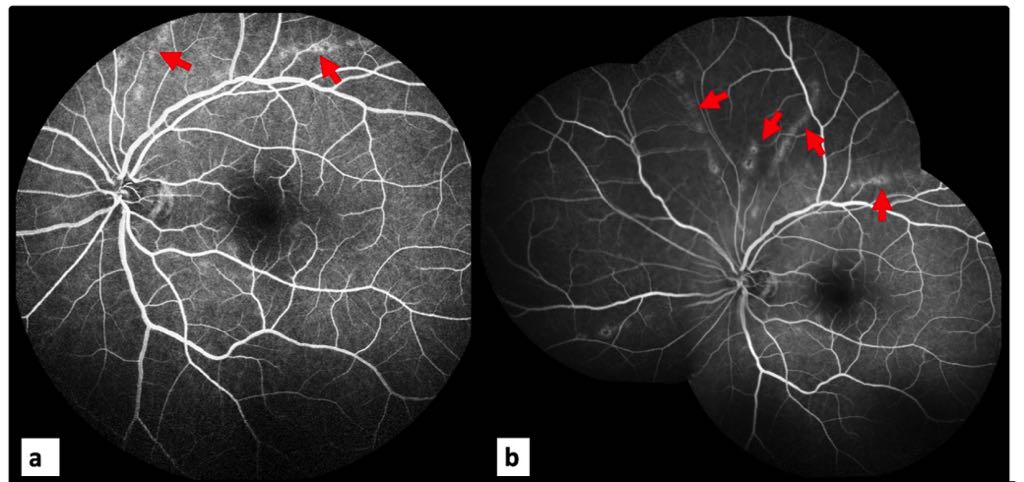
- Early cases showed vitritis, vascular sheathing, and intraretinal hyperreflective dots (inflammatory cells or photoreceptor debris).
- Infectious/inflammatory workups and respiratory viral antigen tests were negative despite concurrent influenza A outbreak.
💊 Treatment
- All received corticosteroids (oral or IV); 7/8 also got IV immunoglobulin.
- No antiviral therapy reported.
- Effectiveness of treatment uncertain due to lack of untreated/control cases.
🔬 Differential Diagnosis & Comparisons
- Shares features with:
- MEWDS – but HORD is bilateral, more severe, and leaves permanent damage.
- AZOOR – similar OCT signs but different age group and distribution.
- Nonparaneoplastic autoimmune retinopathy (np-AIR) – possible molecular mimicry, but rare in children and differs in course.
- Possible analogy to autoimmune encephalitis (“brain on fire”) → antibody-mediated neuroinflammation.
🧪 Research Gaps
- No known antiretinal antibodies detected; possible novel antibody.
- Whole-exome sequencing found no pathogenic variants, but a two-hit hypothesis (genetic susceptibility + inflammatory trigger) is possible.
- Further immune profiling and genetic studies needed.
📌 Takeaway
HORD may be a new pediatric retinal inflammatory disorder causing rapid photoreceptor destruction after viral illness, with partial visual recovery but lasting structural damage.
Future cases could clarify:
- Pathogenesis (immune targets, genetic predisposition)
- Optimal treatment timing and type
- Long-term prognosis and recurrence risk
| Feature | HORD | MEWDS | AZOOR | np‑AIR |
|---|---|---|---|---|
| Typical Age | 3–7 years (pediatric) | Young adults (20–40) | Young to middle‑aged adults | Middle‑aged or older |
| Onset | Sudden, bilateral, severe vision loss after febrile illness | Acute, unilateral, mild–moderate vision loss | Subacute, often unilateral at onset | Gradual, bilateral |
| Fundus Findings (Early) | Minimal changes; possible vitritis, vascular sheathing, intraretinal hyperreflective dots | Multiple white dots at RPE level | Minimal fundus changes | Often normal early |
| OCT Findings | Ellipsoid zone & external limiting membrane disruption; outer retinal thinning | Disruption of ellipsoid zone in affected areas | Localized outer retinal loss | Diffuse outer retinal atrophy |
| ERG | Extinguished photopic & scotopic responses | Usually normal or mildly reduced | Reduced in affected areas | Severely reduced or extinguished |
| Course | Partial visual recovery; persistent structural damage | Spontaneous recovery in weeks | Chronic, progressive in some | Progressive without treatment |
| Presumed Mechanism | Post‑viral immune‑mediated photoreceptor injury | Inflammatory, possibly viral trigger | Autoimmune or viral trigger | Autoimmune (antiretinal antibodies) |
| Treatment | Corticosteroids ± IVIG; effect unclear | Often none needed | Immunosuppression in some | Immunosuppression essential |
| Prognosis | Central vision often improves; ERG remains abnormal | Excellent | Variable | Poor without treatment |
JAMA Ophthalmol. 2025;143(3):222-229. doi:10.1001/jamaophthalmol.2024.6372