-
Patient Presentation:
-
Asymptomatic male in his 40s with no relevant ocular, medical, or family history.
-
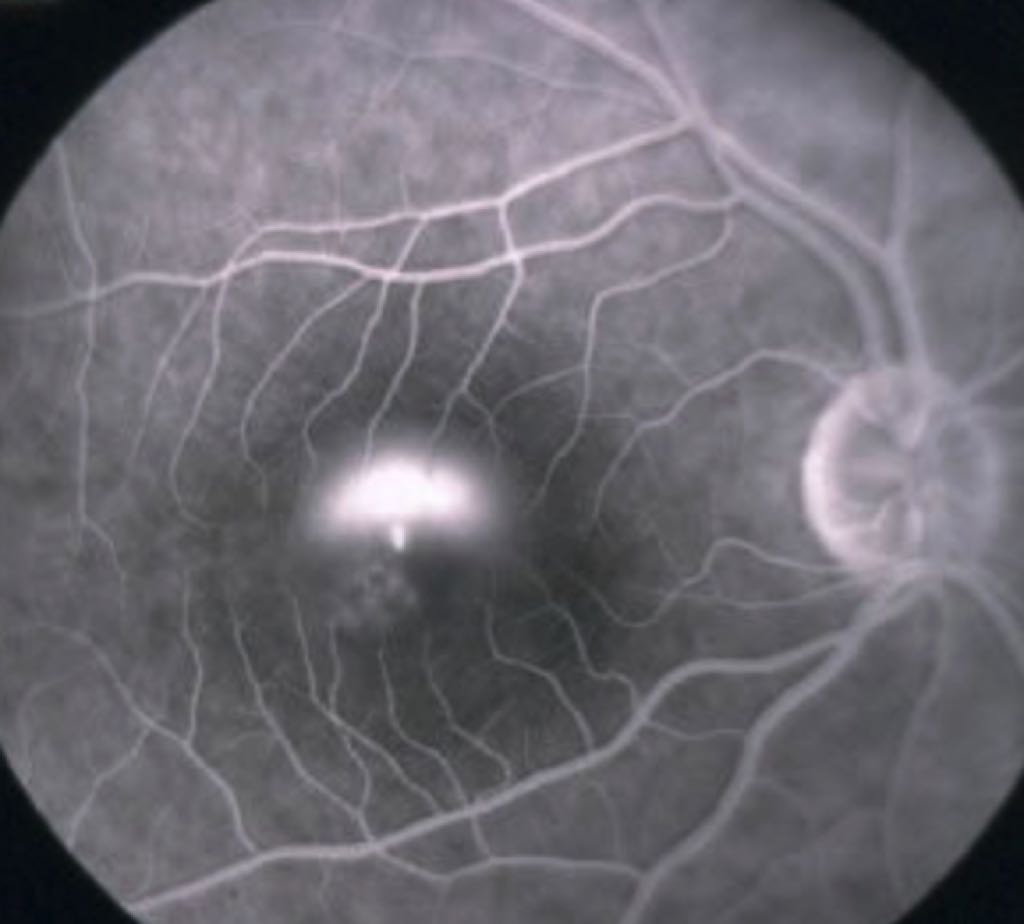
Referred for retinal pigment epithelium (RPE) defect in the right eye.
-
Visual acuity 20/20 in both eyes (OU).
-
Diagnosed with central serous chorioretinopathy (CSCR)-related pigment epithelial detachment (PED) via optical coherence tomography (OCT).
-
-
Clinical Course:
-
Monitored for 4 years with stable visual acuity (20/20 OU) and mild metamorphopsia reported at the most recent visit.
-
PED persisted but resolved temporarily on two occasions (18 months and 4 years post-presentation), only to relapse within an hour during clinic visits.
-
-
Key Observation:
-
PED resolved on initial undilated OCT but relapsed after pupil dilation with 2.5% phenylephrine, observed on slit-lamp biomicroscopy and confirmed by repeat OCT (1 hour later).
-
This pattern occurred twice (at 18 months and 4 years), suggesting a temporal association between phenylephrine use and PED relapse.
-

-
Pathophysiology Insights:
-
CSCR is associated with PED in 53% to 100% of cases, indicating high prevalence.
-
CSCR pathophysiology involves:
-
Hyperpermeable choroid.
-
Loss of RPE barrier and pump function.
-
Hormonal dysregulation (e.g., catecholamines, glucocorticoids).
-
-
Catecholamines (e.g., phenylephrine, epinephrine) may contribute to CSCR and PED:
-
Higher serum catecholamine levels reported in CSCR patients.
-
Case series linked CSCR to pseudoephedrine and methamphetamine use.
-
Neonatal case of PED after phenylephrine use in retinopathy of prematurity.
-
Animal models show epinephrine induces CSCR-like features and RPE apoptosis, impairing barrier and pump function.
-
-
-
Mechanism of Phenylephrine:
-
Phenylephrine (2.5% topical) may upregulate cyclic adenosine monophosphate (cAMP), impairing RPE pump function and leading to subretinal fluid accumulation.
-
Temporal association suggests phenylephrine as a potential trigger for PED relapse in CSCR, though causality is not definitively proven.
-
-
High-Yield Exam Points:
-
CSCR is a common cause of PED and serous retinal detachment, often affecting young to middle-aged males.
-
OCT is critical for diagnosing and monitoring CSCR and PED.
-
Catecholamines (e.g., phenylephrine) are an emerging risk factor for CSCR exacerbation, alongside glucocorticoids.
-
Avoiding unnecessary use of sympathomimetic agents like phenylephrine in CSCR patients may prevent PED relapse.
-
Conservative management with monitoring is standard for asymptomatic CSCR with stable vision.
-
-
Clinical Implications:
-
Clinicians should consider the potential role of topical phenylephrine in CSCR patients undergoing dilated exams.
-
Alternative dilation agents (e.g., tropicamide) may be safer in CSCR patients to avoid triggering PED relapse.
-
Watson MJ, Yellachich D. Relapsing Pigment Epithelial Detachment in Central Serous Chorioretinopathy After Dilated Eye Examination. JAMA Ophthalmology. Published online January 30, 2020. Available at: https://jamanetwork.com/ by a Cambridge University Library User on 02/03/2020.