Myopia, or nearsightedness, is a growing global health concern, especially in East Asia. High myopia, defined as a myopic refractive error worse than -6.00 diopters (D), can lead to severe elongation of the eye and increase the risk of complications like retinal detachment, glaucoma, and scleral thinning.
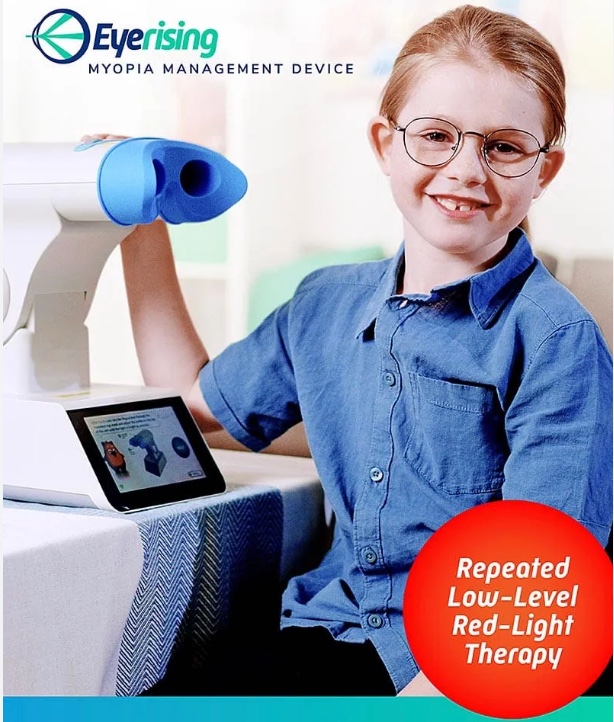
A recent study explored a novel approach to managing high myopia in children: repeated low-level red-light (RLRL) therapy.
Study Design and Methods
Researchers conducted a 12-month, multicenter, randomized, parallel-group, single-blind clinical trial. The study included 202 children aged 7 to 12 years with high myopia (≤-6.00 D). Participants were divided into two groups:
- Intervention Group: Received RLRL therapy along with single vision spectacles.
- Control Group: Received single vision spectacles only.
The RLRL treatment involved administering 650 nm red light for 3 minutes, twice daily, with at least a 4-hour interval between sessions. The primary outcome measured was the change in axial length (AL) at 12 months compared to baseline. Secondary outcomes included changes in spherical equivalent (SE) refraction, choroidal thickness (ChT), and retinal thickness (RT).
Key Findings
The study revealed significant differences between the RLRL and control groups after 12 months:
- Axial Length (AL) Changes: The RLRL group showed an average AL change of -0.11 ± 0.25 mm, indicating axial shortening. In contrast, the control group showed an AL increase of 0.32 ± 0.09 mm.
- Axial Shortening: 59% of children in the RLRL group experienced axial shortening greater than 0.05 mm, compared to 0% in the control group.
- Spherical Equivalent (SE) Changes: The RLRL group had an SE change of 0.18 ± 0.63 D, while the control group had a change of -0.80 ± 0.42 D.
- Choroidal Thickness (ChT): In the RLRL group, ChT increased in all sectors at 12 months. Conversely, the control group showed a significant thinning of ChT in all sectors.
- Retinal Thickness (RT): RT increased in the parafoveal and perifoveal circles in the RLRL group. The control group, however, only showed a significant thinning of RT in the perifoveal circle.
- Correlation Between Retinal and Choroidal Changes: The study found significant correlations between changes in ChT in the central foveal circle and RT in the perifoveal circle at 1 month and AL changes at 12 months.
- Safety: No fundus structure changes, afterimage exceeding 6 minutes, or decrease in best-corrected visual acuity were reported in the RLRL group.
Conclusion
The study demonstrates that repeated low-level red-light (RLRL) therapy can effectively inhibit the progression of myopia and induce axial shortening in children with high myopia. The observed changes, including axial shortening and SE regression, appear to be associated with increases in choroidal and retinal thickness.
This research suggests that RLRL therapy is a safe and promising alternative treatment for managing high myopia in children, offering a potential breakthrough in myopia control.